

The Core Pillars of Scaling Service Businesses
To build a service business that truly scales, we must establish a robust foundation. Think of it like constructing a skyscraper: without strong, well-engineered pillars, the structure will eventually crumble under its own weight. For service businesses, these core pillars include repeatable systems, a solid technology infrastructure, strategic hiring practices, unwavering financial health, and an exceptional customer experience.
Each pillar supports the others, creating a cohesive framework that allows for exponential growth rather than merely linear expansion.
- Repeatable Systems and Processes: At the heart of scalability lies the ability to deliver consistent quality, regardless of volume. This requires documenting every critical operational step, from client onboarding to service delivery and invoicing. When processes are clear and repeatable, they reduce reliance on individual expertise, making it easier to train new staff and maintain quality as we expand.
- Technology Infrastructure: Modern scaling is impossible without leveraging technology. This pillar encompasses everything from CRM systems and project management tools to automation software and communication platforms. A well-integrated tech stack streamlines operations, enhances efficiency, and provides invaluable data for decision-making.
- Strategic Hiring and Team Management: Scaling isn’t just about adding more bodies; it’s about building a high-performing team. This involves hiring individuals who align with our company culture, investing in their training, and empowering them through delegation. Without a capable and motivated team, even the best systems will falter.
- Financial Health and Foresight: Sound financial management is the bedrock of sustainable scaling. This includes understanding our profit margins, managing cash flow effectively, and having adequate capital reserves for investment and unexpected challenges. Without financial stability, rapid expansion can quickly lead to financial distress.
- Exceptional Customer Experience: In an increasingly competitive landscape, customer experience is a critical differentiator. We know that roughly 52% of customers will switch to a competitor after just one bad experience. Maintaining high service quality and ensuring customer satisfaction are paramount during scaling. Happy customers lead to retention, referrals, and a stronger brand reputation, all of which fuel sustainable growth.
By focusing on these interconnected pillars, we can ensure that our service business is not only growing but scaling intelligently, ready to meet increased demand without compromising quality or profitability.
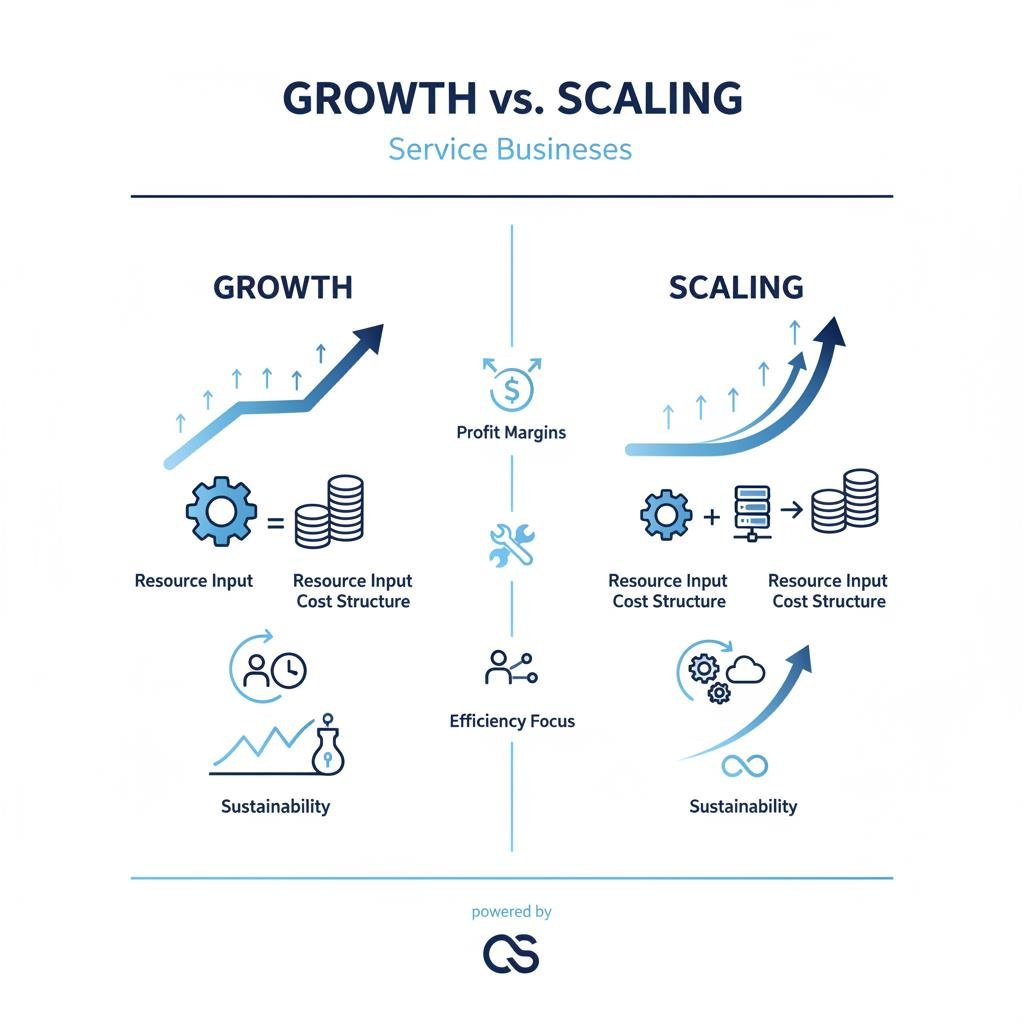
An insightful way to visualize the distinction between growing and scaling is through their fundamental resource implications:
Feature Linear Growth Exponential Scaling Resource Input Proportional increase with revenue Minimal or non-proportional increase with revenue Cost Structure Costs rise in tandem with revenue Costs remain relatively stable or grow slowly Profit Margins Often stable or slightly decreasing Typically expand significantly Efficiency Focus Primarily on increasing output Primarily on optimizing processes and systems Dependency High reliance on individual effort and time High reliance on automated systems and repeatable frameworks Sustainability Can be resource-intensive, prone to bottlenecks Designed for long-term, self-sustaining expansion.
Operational Excellence: Systems, Automation, and Productization
Achieving operational excellence is non-negotiable for scaling a service business. This means moving beyond ad-hoc solutions and establishing robust Standard Operating Procedures (SOPs), embracing workflow automation, and integrating critical tools like CRM systems. These elements work in concert to create a streamlined, efficient, and predictable service delivery model.
Documenting SOPs is the first step. These detailed guides ensure consistency across all service offerings, providing a blueprint for every task. From client intake to project completion, clear SOPs minimize errors, reduce training time for new hires, and guarantee a uniform experience for customers. This systematization is crucial for maintaining quality as volume increases.
Workflow automation takes these documented processes and supercharges them. Repetitive, manual tasks—such as sending follow-up emails, scheduling appointments, or generating reports—can be automated, freeing up valuable human resources. For example, businesses utilizing field service software have seen significant revenue increases, with some platforms reporting a 35% revenue boost after just one year. This efficiency gain allows our team to focus on higher-value activities that require human creativity and problem-solving, rather than getting bogged down in administrative overhead.
CRM integration is another cornerstone of operational excellence. A centralized CRM system acts as the single source of truth for all client interactions, data, and project statuses. It enables seamless communication, personalized service, and data-driven insights into customer behavior and preferences. This integration is vital for managing client relationships at scale, ensuring no client falls through the cracks as our business expands.
Furthermore, digital marketing plays a critical role in feeding these optimized operations with a consistent stream of leads. For instance, effective digital advertising strategies, including those managed through platforms like scaling service business Google Ads, can drive targeted traffic and qualified inquiries directly into our streamlined sales funnels. This allows us to leverage our operational efficiency to convert leads into loyal customers more effectively.
Looking at market trends, we see the growing importance of diverse marketing channels. While digital advertising continues to dominate, traditional methods can still be effective for local services; for example, 70% of homeowners are reported to look at their direct mail on the day it arrives. Meanwhile, the broader shift towards digital commerce, with eCommerce projected to account for 23% of global retail sales by 2027, underscores the necessity for service businesses to have strong online presence and digital operational capabilities.
By focusing on SOPs, automation, and integrated technology, we build an operational backbone that can handle increased demand without proportional increases in cost or complexity.
How to Productize for Scaling Service Businesses
Productization is a game-changer for service businesses aiming to scale beyond the limitations of trading time for money. It involves transforming bespoke, customized services into standardized, repeatable offerings that can be sold and delivered more efficiently. This strategic shift allows us to decouple our revenue growth from a direct, linear increase in labor hours.
The core of productization lies in creating standardized deliverables. Instead of crafting a unique solution for every client, we define a clear scope of work, expected outcomes, and delivery process for each service offering. This allows us to create templates, checklists, and automated workflows that ensure consistency and quality at scale.
Tiered pricing and subscription models are common productization strategies. Rather than hourly billing, we can offer packages at different price points (e.g., “Basic,” “Pro,” “Enterprise”) with clearly defined features and benefits. This not only simplifies sales but also creates predictable, recurring revenue streams, which are essential for stable growth and investment. Subscription models, in particular, foster long-term client relationships and reduce customer acquisition costs over time.
By productizing, we transform our scalable expertise into tangible, sellable units. This could mean turning a complex consulting engagement into an online course, a group coaching program, or a fixed-price audit. The goal is to capture our intellectual property and deliver it in a way that doesn’t require constant, direct involvement from our most senior experts for every client.
Value-based packages shift the focus from the hours we spend to the results we deliver. Clients pay for the value they receive, not the time it takes us to provide it. This often leads to higher profit margins, as our efficiency gains directly contribute to our bottom line. Productization is about decoupling time from money, allowing us to serve more clients, generate more revenue, and achieve greater profitability without proportionally increasing our operational overhead or burning out our team.
Effective Automation for Scaling Service Businesses
Automation is a powerful lever for scaling, enabling service businesses to handle increased volume and complexity without linearly expanding their workforce. By strategically automating routine tasks, we can boost efficiency, reduce costs, and improve service delivery.
Consider appointment scheduling. Manual scheduling is time-consuming and prone to errors. Automated systems allow clients to book appointments online, check availability, and receive instant confirmations and reminders. This not only saves staff time but also reduces no-shows and improves the customer experience.
Similarly, automated invoicing and payment processing streamline financial operations. Systems can automatically generate invoices, send payment reminders, and process transactions, significantly reducing administrative burden and improving cash flow.
Customer communication can also be largely automated. Welcome sequences, feedback requests, service updates, and even personalized follow-ups can be triggered automatically, ensuring consistent engagement without requiring constant manual effort. This is particularly valuable for maintaining strong client relationships as our client base grows.
For businesses dealing with a high volume of inquiries, lead qualification can be automated through chatbots or AI-driven forms. These tools can gather essential information from potential clients, answer frequently asked questions, and even pre-qualify leads before they reach our sales team, ensuring our sales efforts are focused on the most promising prospects.
The rise of AI-driven support is further transforming automation capabilities. AI chatbots can handle 60-80% of routine customer inquiries, providing instant answers and freeing up human agents for more complex issues. This not only enhances customer satisfaction through rapid responses but also significantly reduces the cost of customer service as we scale.
Effective automation is about reducing manual bottlenecks. By identifying repetitive, rule-based tasks and automating them, we create a leaner, more efficient operation that can scale gracefully. This allows our team to focus on strategic initiatives, complex problem-solving, and delivering personalized value, rather than being consumed by mundane, time-consuming activities.
Building a Scalable Team and Infrastructure
The journey to scaling a service business is deeply intertwined with our ability to build and manage a high-performing team and the infrastructure that supports them. It’s not just about hiring more people; it’s about hiring the right people and empowering them with the right tools and processes.

A culture-first hiring approach is paramount. We look for individuals who not only possess the necessary skills but also align with our core values and vision. This ensures that as our team grows, our company culture remains strong and cohesive. Hiring for cultural fit minimizes turnover and fosters a more engaged, productive workforce. The cost of employee turnover can be substantial, often ranging from one-half to two times an employee’s annual salary, making retention a critical component of scaling effectively.
Identifying and nurturing “trailblazer” employees is another key strategy. These are individuals who are eager to take ownership, refine processes, and lead by example. They can help document workflows, train new team members, and champion new initiatives, becoming invaluable assets in disseminating our operational knowledge.
Strategic outsourcing of non-core tasks allows our internal team to focus on our core competencies. Activities like administrative support, specialized marketing functions, or IT management can often be outsourced to experts, providing flexibility and cost efficiency without diluting our internal focus. For instance, a local service provider like a company offering Victorville garage door services might outsource their bookkeeping or digital advertising management to focus their internal team entirely on expert installations and repairs. This allows them to scale their core offering without needing to build out extensive internal departments for every support function.
Robust training systems are essential for integrating new hires quickly and ensuring consistent service quality. Standardized onboarding programs, ongoing professional development, and access to a comprehensive knowledge base empower employees to perform at their best from day one.
Leadership delegation is critical as we scale. Business owners must transition from being involved in every detail to empowering managers and team leaders to make decisions. This requires trust, clear communication, and well-defined roles and responsibilities. Without effective delegation, the owner becomes a bottleneck, limiting the business’s capacity for growth.
Finally, proactive capacity planning ensures we have the right number of people with the right skills at the right time. This involves forecasting demand, identifying potential skill gaps, and planning recruitment cycles well in advance. By anticipating our staffing needs, we can avoid last-minute hiring scrambles and ensure a smooth scaling trajectory.
Financial Readiness and Risk Management
Financial readiness is the bedrock upon which successful scaling is built. Without a clear understanding of our financial position and a robust risk management strategy, even the most promising growth initiatives can falter. The statistic that 74% of startups fail due to premature scaling often points to underlying financial missteps.

A critical focus must be on gross margins. For B2B service firms, healthy gross margins typically range from 35-55% on core offerings. Regularly auditing our profitability helps identify which services are most lucrative and where we might need to adjust pricing or delivery methods. Ignoring margins during growth can lead to what’s known as “profitless prosperity,” where revenue increases but the bottom line shrinks.
Effective cash flow management is equally vital. Growth eats cash, and expanding operations often requires significant upfront investment in technology, marketing, and team expansion before new revenue fully materializes. We must ensure a steady inflow of cash to cover these expenses and maintain liquidity. This involves diligent invoicing, efficient collections, and careful management of payables.
KPI tracking provides the objective data needed to make informed financial decisions. Monitoring key performance indicators related to revenue, costs, and profitability allows us to identify trends, spot potential issues early, and adjust our strategies as needed.
Maintaining adequate capital reserves is a non-negotiable aspect of risk management. Having 3-6 months of operating expenses in reserve provides a buffer against unexpected downturns, allows for strategic investments, and provides peace of mind during periods of rapid change. This financial cushion is crucial for navigating the uncertainties inherent in scaling.
Finally, regular profitability audits help us continuously assess the financial health of our business. These audits go beyond basic accounting to analyze the profitability of individual services, client segments, and operational processes. By understanding where our profits truly come from, we can strategically allocate resources to maximize our financial returns and ensure sustainable scaling.
Financial Metrics for Scaling Service Businesses
To effectively navigate the financial complexities of scaling, we rely on a suite of key performance indicators (KPIs). These metrics provide a data-driven lens through which to assess our financial health, identify areas for improvement, and make strategic decisions.
- Customer Acquisition Cost (CAC): This metric tells us how much it costs to acquire a new customer. As we scale, it’s crucial to ensure our CAC remains sustainable. If our marketing efforts become too expensive per new client, our growth will be unprofitable.
- Customer Lifetime Value (CLV): CLV represents the total revenue we expect to generate from a customer over their relationship with our business. A high CLV indicates strong customer retention and satisfaction, which are vital for long-term profitability. Ideally, our CLV should significantly outweigh our CAC.
- Churn Rate: The percentage of customers who stop using our services over a given period. High churn erodes revenue and forces us to constantly acquire new customers just to stay even. Minimizing churn is a powerful way to ensure sustainable growth and improve CLV.
- Billable Utilization: This metric measures the percentage of an employee’s available time that is spent on billable work. For service businesses, optimizing utilization (e.g., targeting 70-75% for senior staff and 80-85% for delivery staff) ensures that our team’s time is efficiently converted into revenue.
- Revenue Per Employee: This KPI indicates how much revenue each employee generates. As we scale, we aim to increase this figure, demonstrating improved efficiency and productivity across our team.
- Working Capital: The difference between current assets and current liabilities. Healthy working capital ensures we have enough liquid assets to cover short-term obligations and fund day-to-day operations during growth phases.
- Break-Even Analysis: This analysis helps us determine the point at which our revenue covers all our costs. When launching new services or expanding into new markets, a break-even analysis is crucial for understanding the financial viability and required volume for profitability.
By consistently tracking and analyzing these financial metrics, we gain the insights needed to make informed decisions, optimize our resource allocation, and ensure that our scaling efforts lead to sustained profitability.
Frequently Asked Questions about Scaling
What is the main difference between growth and scaling?
The fundamental distinction between growth and scaling lies in the relationship between revenue and cost. Growth typically implies an increase in revenue, but often with a proportional increase in resources, expenses, and operational complexity. If we double our client base and need to double our staff, office space, and administrative overhead, that’s growth. Our profit margins might remain stable or even shrink due to increased costs.
Scaling, on the other hand, is about increasing revenue at a significantly faster rate than expenses. It’s about achieving exponential gains with only linear or even sub-linear increases in resources. This is accomplished through efficiency, automation, and repeatable systems. When we scale, our profit margins expand because we’re generating more revenue without a corresponding proportional rise in costs. It shifts from a linear resource allocation model to one focused on maximizing output from existing inputs.
How do I know if my service business is ready to scale?
Determining readiness to scale is crucial to avoid the pitfalls of premature expansion. We look for several key indicators:
- Consistent Market Demand: Are we consistently turning away clients or have a significant waitlist? This indicates a clear demand for our services that exceeds our current capacity.
- Operational Stability: Can our business run smoothly without the owner’s constant, day-to-day involvement? If we can take a week’s vacation without checking our phone and the business thrives, our systems are likely robust enough.
- Strong Financial Reserves: Do we have 3-6 months of operating expenses in reserve? Scaling requires investment, and a healthy financial cushion is essential to navigate growth phases.
- Owner Independence: Have we successfully delegated key responsibilities and built a leadership team that can manage operations? If the business is still entirely dependent on the owner, it’s not ready to scale.
- High Utilization Rate: For service providers, a consistent utilization rate of 80% or more for our team often signals it’s time to expand capacity. This indicates that our current resources are fully optimized and ready for additional demand.
If these conditions are met, we are likely well-positioned to embark on a strategic scaling journey.
What are the biggest mistakes to avoid when scaling?
Scaling is fraught with potential missteps, and recognizing these common mistakes can help us navigate the process more effectively:
- Hiring Too Early or Too Rapidly: Adding staff before systems are in place or before demand truly justifies it can quickly bloat overhead and erode profits. It’s crucial to hire strategically, often only when existing capacity is consistently maxed out.
- Ignoring Profit Margins: Focusing solely on revenue growth without paying attention to the profitability of each service or client can lead to “profitless prosperity.” We must continuously monitor and protect our margins.
- Reliance on Manual Processes: Attempting to scale a business built on manual, ad-hoc processes is a recipe for chaos. Manual bottlenecks will quickly overwhelm the team and limit growth. Automation and systematization must precede or accompany scaling.
- Compromising Customer Experience: As demand increases, it’s tempting to cut corners. However, neglecting customer experience can lead to high churn rates, negative reviews, and a damaged reputation, undermining the very foundation of sustainable growth.
- Lack of Data-Driven Decisions: Scaling without accurate data on KPIs, market trends, and financial performance is like flying blind. Decisions should be informed by metrics, not just gut feelings.
By proactively addressing these potential pitfalls, we can increase our chances of achieving successful and sustainable scaling.
Conclusion
The journey of scaling a service business is an exciting, yet challenging, endeavor that demands foresight, discipline, and strategic execution. As we look towards April 2027 and beyond, the businesses that will thrive are those that embrace a leadership mindset focused on systematization, operational excellence, and sustainable expansion.
We’ve explored the critical distinction between growth and true scaling—the ability to increase revenue exponentially without a proportional rise in costs. This is achieved by building strong foundational pillars: repeatable systems, robust technology, strategic team building, unwavering financial health, and an uncompromised customer experience.
From productizing our offerings to decouple time from money, to leveraging automation for efficiency, and building a culture-first team, each element plays a vital role in creating a resilient and adaptable business. Our financial readiness, driven by diligent KPI tracking and cash flow management, serves as the engine for this expansion, mitigating the risks associated with rapid growth.
Scaling is about transforming our service business into a self-sustaining asset, one that can deliver consistent value to more clients, generate greater profitability, and offer more freedom to its leaders. By meticulously crafting a strategic roadmap, continuously optimizing our processes, and fostering a culture of innovation, we can confidently navigate the complexities of scaling and future-proof our success for years to come.