Key Takeaways
- Non-destructive excavation methods enhance safety and precision in construction projects.
- Techniques such as hydro excavation and vacuum excavation help prevent damage to underground utilities.
- Advanced technologies such as Ground Penetrating Radar (GPR) and robotic inspection tools further improve excavation accuracy.
Non-destructive excavation techniques are transforming construction and utility work throughout North Texas and the Dallas-Fort Worth region. By relying on advanced methods, such as hydro-excavation, companies can uncover vital infrastructure without risk to buried utilities. This approach not only safeguards critical pipelines and communication lines but also avoids costly project setbacks and environmental harm. Companies like Kyle Erwin Construction, known for their expertise in North Texas hydrovac services, are leading the charge by offering highly accurate excavation and minimal damage risk in sensitive environments.
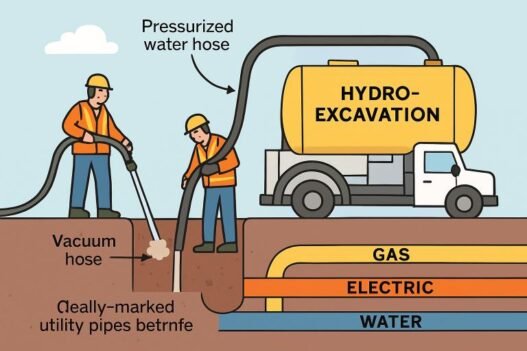
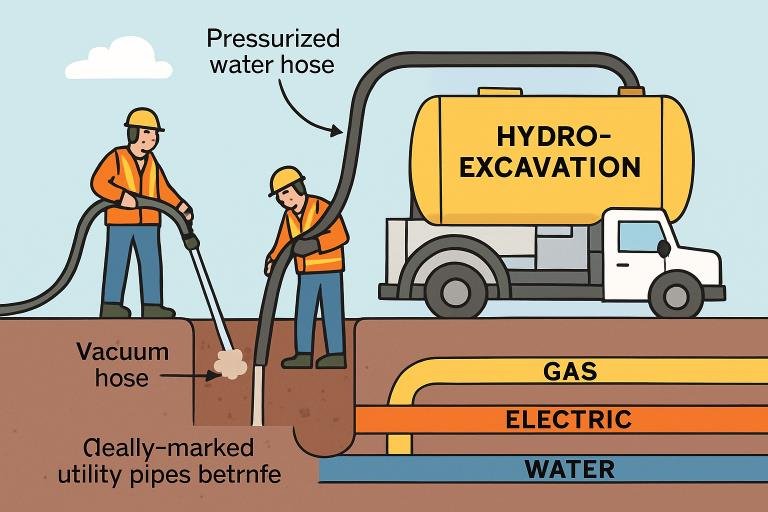
Pressurized water and vacuum systems are vital in hydro-excavation, safely removing soil around underground assets without mechanical digging, reducing the risk of breaks or leaks. As urban areas grow and networks become complex, hydro-excavation is recognized as a safe, efficient method for sensitive projects. It’s used for daylighting, potholing, and pipeline exposure, providing clean, precise holes that boost productivity and safety while minimizing environmental impact, ideal for urban renewal. In commercial, industrial, and municipal work, hydro-excavation companies add value by accurately and quickly assessing sites, minimizing service disruptions and environmental harm, ensuring compliance, and lowering costs.
For energy-specific infrastructure projects, partnering with experts in hydro excavation for pipelines ensures regulatory compliance and the highest level of safety when handling oil and gas lines, water mains, and electrical conduits.
Hydro Excavation: Combining Power and Precision
Hydro-excavation uses a controlled stream of high-pressure water to break up soil, which is then siphoned away by a powerful industrial vacuum. This combination allows for ultra-precise digging, enabling operators to work directly around sensitive underground infrastructure without making direct contact. As reported by the American Society of Civil Engineers, hydro-excavation is now the preferred approach for exposing underground utilities in many urban centers due to its unmatched safety record and operational efficiency.
This method drastically reduces the possibility of utility strikes, which can lead to hazardous leaks, service outages, or even injuries. Because of its precision and low risk, hydro-excavation is frequently required by utility companies, municipalities, and private contractors when working near active infrastructure or in densely networked urban environments.
Vacuum Excavation: Safe and Efficient Soil Removal
Vacuum excavation, also known as soft digging, uses air or water to loosen the soil before it is sucked up and transported away using a high-powered vacuum system. This process not only protects existing underground utilities but is also quieter, cleaner, and less disruptive to ongoing site activities and nearby communities. Proper use of vacuum technology supports environmental sustainability by drastically limiting the migration of contaminated soil and runoff. According to the Occupational Safety and Health Administration, vacuum excavation significantly reduces worker exposure to hazards common in traditional open-trench digging.
Ground Penetrating Radar (GPR): Seeing Before Digging
Ground Penetrating Radar is a non-intrusive technology that employs electromagnetic signals to map subsurface structures. GPR is indispensable for pre-excavation planning and for identifying the exact locations of utilities, voids, and other underground obstacles before machinery is even deployed. Its effectiveness minimizes unnecessary excavation, enables highly targeted hydrovac operations, and further reduces the project’s overall risk profile.
Robotic Inspection Tools: Enhancing Safety and Accuracy
Advancements in remote inspection technologies mean that robots equipped with GPR or video cameras can travel through underground pipes and channels, providing real-time data without exposing workers to confined spaces or hazardous materials. These tools are particularly effective for infrastructure maintenance as they gather critical condition data while leaving surfaces and structures undisturbed. The use of robotics has been shown to improve accuracy and speed of inspections, helping teams identify problem areas before they escalate and reducing costly downtime.
Air Excavation: A Dry Alternative
Air excavation offers a dry alternative to hydro-excavation by using compressed air instead of water to break up and remove soil. This method is essential in areas with water use restrictions or in applications where excess moisture could have negative consequences. By gently agitating the earth with air, operators can expose buried cables or roots with less mess, no risk of damaging electrical lines, and minimal environmental disturbance.
Electromagnetic Induction: Locating Utilities Efficiently
This technique uses a transmitter to emit electromagnetic signals into the ground. These signals reflect off metallic or conductive utilities and are detected by a receiver, enabling precise mapping without digging. Electromagnetic induction is highly effective for quickly locating utilities in large or complex areas, especially when paired with GPR and other mapping technologies in a comprehensive site assessment.
Conclusion
Adoption of non-destructive excavation techniques, such as hydro-excavation, vacuum excavation, GPR, robotic inspection tools, air excavation, and electromagnetic induction, offers multiple benefits for construction and utility projects. These methods protect community infrastructure, limit environmental disturbance, and ensure site safety, making them the standard for efficient and responsible excavation. With increasing demand for reliable project execution, North Texas firms like Kyle Erwin Construction are setting the benchmark for delivering safe, timely, and high-precision excavation services.